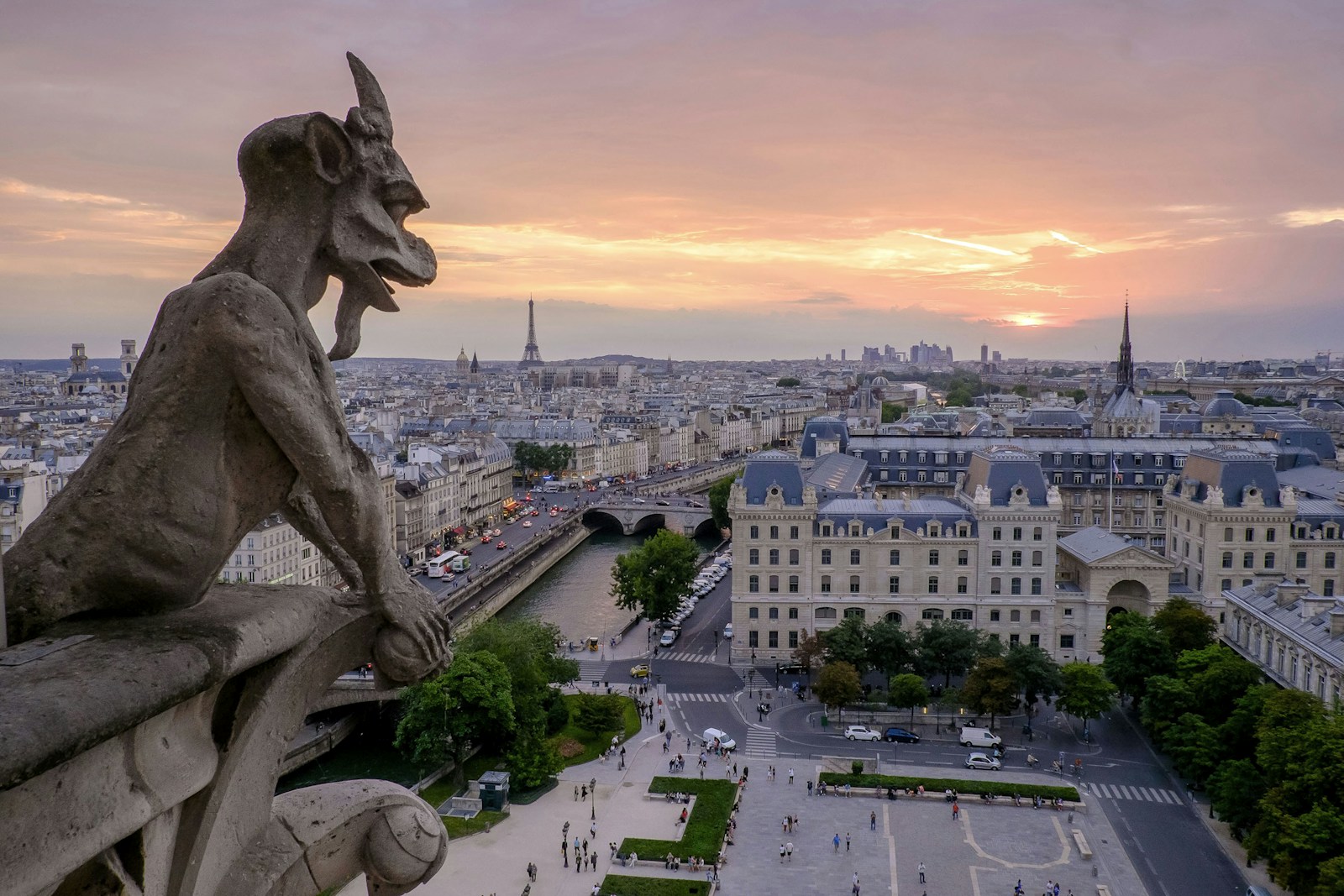
Notre-Dame Cathedral
Reopened December 2024. Restored. More beautiful than before.
Cathedral entry is free and walk-in. Tower climb requires a separate timed ticket booked online — slots sell out weeks ahead in summer. Book at notredamedeparis.fr.
The fire and the restoration
On 15 April 2019, a fire broke out in the attic of Notre-Dame during renovation work. The 93-metre spire — designed by Eugène Viollet-le-Duc in the 19th century — collapsed within an hour. The fire destroyed most of the medieval oak roof structure ("the Forest") and two-thirds of the lead covering. The international response was extraordinary: over €840 million was pledged for restoration within days.
The restoration, completed in time for the cathedral's reopening on 7 December 2024, is widely considered a triumph. The new spire is taller and more ornate than the one that burned — closer to Viollet-le-Duc's original ambition than the 19th-century construction achieved. The interior has been entirely re-illuminated; the stone cleaned. Many visitors report the restored cathedral is more beautiful than the one they remember before the fire.
What to see inside
The Rose Windows
Three enormous circular stained glass windows, the defining feature of the cathedral. The west rose window (over the main entrance, partly 12th century) depicts the Last Judgment. The north rose window (1250, with original 13th-century glass largely intact) is one of the finest medieval windows in the world — blue and red petals radiating from a central image of the Virgin. The south rose window (1257) is equally extraordinary. All three survived the fire.
The Treasury
Houses the Crown of Thorns — purchased by Louis IX (Saint-Louis) in 1239 for a sum that exceeded the annual income of France, and for which Sainte-Chapelle was built. The relic survived the fire. Also: a piece of the True Cross, a nail from the Crucifixion, and the Cathedral's extensive collection of medieval liturgical objects.
The towers
213 steps up the north tower, then 122 more to the south tower gallery. At the top: the great bell Emmanuel (13 tonnes), the famous chimera gallery (Victor Hugo's gargoyle-like demons, added by Viollet-le-Duc in the 19th century — not medieval originals), and a panoramic view of Paris. The tower climb is one of the best experiences in Paris for the views alone.
Victor Hugo and Notre-Dame
The Hunchback of Notre-Dame (Notre-Dame de Paris), published 1831, was written partly as a political act — to pressure the French authorities to properly restore and preserve Gothic architecture that was being demolished across France. The novel specifically describes the damage being done to Notre-Dame by neglect and poorly planned restorations. It worked: Viollet-le-Duc was appointed in 1844 and spent 25 years on the most comprehensive medieval restoration in French history.
Getting there
Metro line 4 to Cité station (exit directly onto the Île de la Cité, 5-minute walk). RER B/C to Saint-Michel–Notre-Dame. The cathedral faces west — the main entrance (west façade) opens onto the Parvis Notre-Dame.
Notre-Dame FAQ
Yes. Notre-Dame reopened on 7 December 2024 — five years after the April 2019 fire that destroyed the spire and much of the roof. The cathedral was fully restored, including a new spire taller and more ornate than the original. Entry to the cathedral itself is free. The towers and treasury require separate tickets.
The three great Rose Windows survived largely intact. The south rose window (13th century) and the north rose window (also 13th century) were the most vulnerable and both survived. The west rose window (the oldest, partly 12th century) also survived. They are among the finest examples of medieval stained glass in existence.
The cathedral interior takes 30–60 minutes. The towers (if you climb them) add another 45–60 minutes. The treasury takes 30 minutes. Allow 2 hours if you're doing everything. Note that tower entry requires a separate timed ticket booked in advance.
The classic view from the Square Jean XXIII (behind the cathedral) shows the flying buttresses and the newly restored spire. The view from Pont de l'Archevêché (the bridge just east) is excellent. The view from Shakespeare and Company bookshop on the opposite bank is the one everyone photographs.
Hugo published The Hunchback of Notre-Dame (Notre-Dame de Paris) in 1831, partly to draw public attention to the cathedral's deterioration and the damage being done by poorly conceived restoration work. The novel worked — it sparked a public campaign for proper restoration, leading to Eugène Viollet-le-Duc's famous 19th-century restoration (including the original spire that burned in 2019).